E-invoicing in B2B Transactions Becomes Mandatory from January 2025
25. May 2024
TX Logistik Expands Its Activities in Sweden
28. May 2024
In logistics, speed, efficiency, and just-in-time processes are crucial. However, finding the right order data in the Warehouse Management System (WMS) is often cumbersome and time-consuming. An AI-based assistant provides answers to questions about processes, technical terminology, or system configurations with just one input. This concept of the WMS assistant greatly simplifies warehouse operations. Alexander Edelmann, Associate Partner at Logistics Reply, outlines the benefits in a guest article.
Von: Alexander Edelmann
(Munich) Digital processes and fully automated data processing already contribute significantly to the economic success of the logistics industry today. The digital handling of the supply chain in the WMS leads to faster throughput times and better process visibility. However, the potential is far from being fully utilized: To make daily work with warehouse management software easier and more efficient, Logistics Reply has developed the AI-based assistant LEApedia for the WMS. The module is based on a so-called multi-agent AI engine that facilitates the analysis of enormous datasets and identifies patterns.
Intuitive Operation Through Natural Language Output
The state-of-the-art language model has been developed to interpret and respond to requests and commands in natural language. The intelligent search function allows for quick and intuitive access to information ranging from specific terms to complex process descriptions. This enables users to interact efficiently with the user-friendly system. If the description in the system is insufficient, employees receive a link to the online user manual. This significantly reduces search times. The program recognizes input questions in natural language and answers them accordingly. This greatly simplifies operation – for both experienced logisticians and beginners or individuals with a migration background who may not yet be familiar with the difficult technical terms. With the AI assistant, users can access important information in the WMS regardless of their qualifications, without having to use technical jargon.
High User Autonomy Increases Productivity
With the WMS application, employees do not waste time on manual searches but receive the sought-after information about processes, technical terminology, system configurations, and more at a glance. The precise and consistent results reduce potential human errors in information retrieval. The input of requests and commands in natural language and the intuitive user interface enhance efficiency and increase user independence: The simple operation reduces the need for support requests during ongoing operations. Regardless of the knowledge and language background of the employees, the AI-based assistant understands questions without specific keywords and technical terms – thus, the use of such an assistant can counteract the shortage of skilled workers. Additionally, the application can serve as a training tool for new employees by providing best practices, instructions, or general information about WMS functions. At the same time, the learning curve in handling the WMS is greatly accelerated, and productivity is increased. The specialized staff is relieved in the long term and can use the time gained for other value-adding activities. Due to the time savings, logistics companies, e-commerce retailers, and SMEs benefit from the released personnel capacities.
AI Integration Without Production Downtime
LEApedia is specifically tailored to the respective customer requirements and software environments. This makes the application suitable for a wide range of user groups – from small businesses to medium-sized transshipment centers to wholesalers. The module can be integrated into the system in no time without slowing down or interrupting operations. Updates can also be carried out during ongoing operations.
The AI assistant draws its data basis from the information available in the WMS. The module allows the use of different information sources that can be customer-specific. At the same time, the solution is easy to maintain. “LEApedia is integrated into the WMS LEA ReplyTM, which is based on microservices. These are independent software components that allow for the individual development of new processes,” explains Alexander Edelmann, Associate Partner at Logistics Reply. Depending on the needs, freely selectable modules can be assembled and updated.
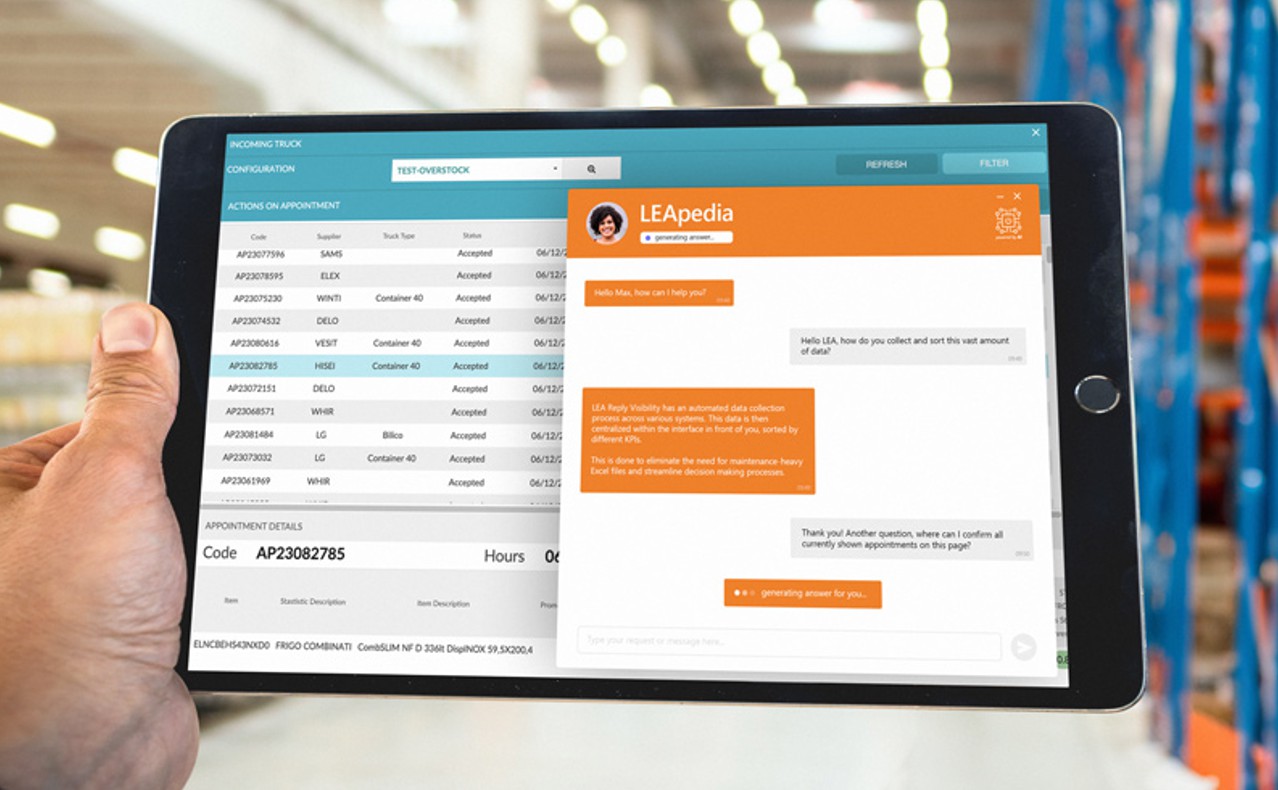 LEApedia is one of three AI pilot projects in LEA ReplyTM, with which Logistics Reply aims to make the WMS even more efficient, simpler, and clearer. In addition to LEApedia, LEA Smart Search and LEA Executive Cockpit are part of the new AI software applications. LEA Smart Search allows users to make data requests in natural language to the system without having to select lengthy search attributes for manual queries. This results in enormous time-saving potential for the control center staff and the administrative employees of a logistics site, who often spend hours daily searching for and evaluating data. The LEA Executive Cockpit is an application that evaluates and prepares operational data for a management view, so decision-makers can get an overview of current business processes at a glance. By integrating the AI-based assistant LEApedia, managers can also save time. Using the previously described technology, the system responds to input questions in natural language with the desired answers and provides decision-makers with the relevant information for the respective situation.
Using an AI Assistant to Utilize the WMS More Efficiently
With an AI assistant, companies can significantly enhance the efficiency of their WMS usage. A bidirectional application like LEApedia leads employees precisely to the information target with just one input. At the same time, the WMS assistant sustainably relieves employees, reduces the likelihood of errors in information retrieval, and significantly shortens search times. This frees up personnel capacities that can be used for other value-adding activities. The software solution offers users entirely new opportunities to efficiently scale their WMS in ongoing warehouse operations and to assert themselves as a company in the dynamic logistics industry.
Alexander Edelmann is an Associate Partner at Logistics Reply and is responsible for the entire German-speaking region. He has extensive knowledge as a supply chain expert and has over 15 years of experience in logistics, warehouse management, and IT. His career includes positions at Fraunhofer IML and PSI Logistics GmbH. From his perspective, artificial intelligence will shape the future of the logistics industry and increasingly support users of logistics software in demanding tasks such as optimized order planning.
Photos: © Logistics Reply