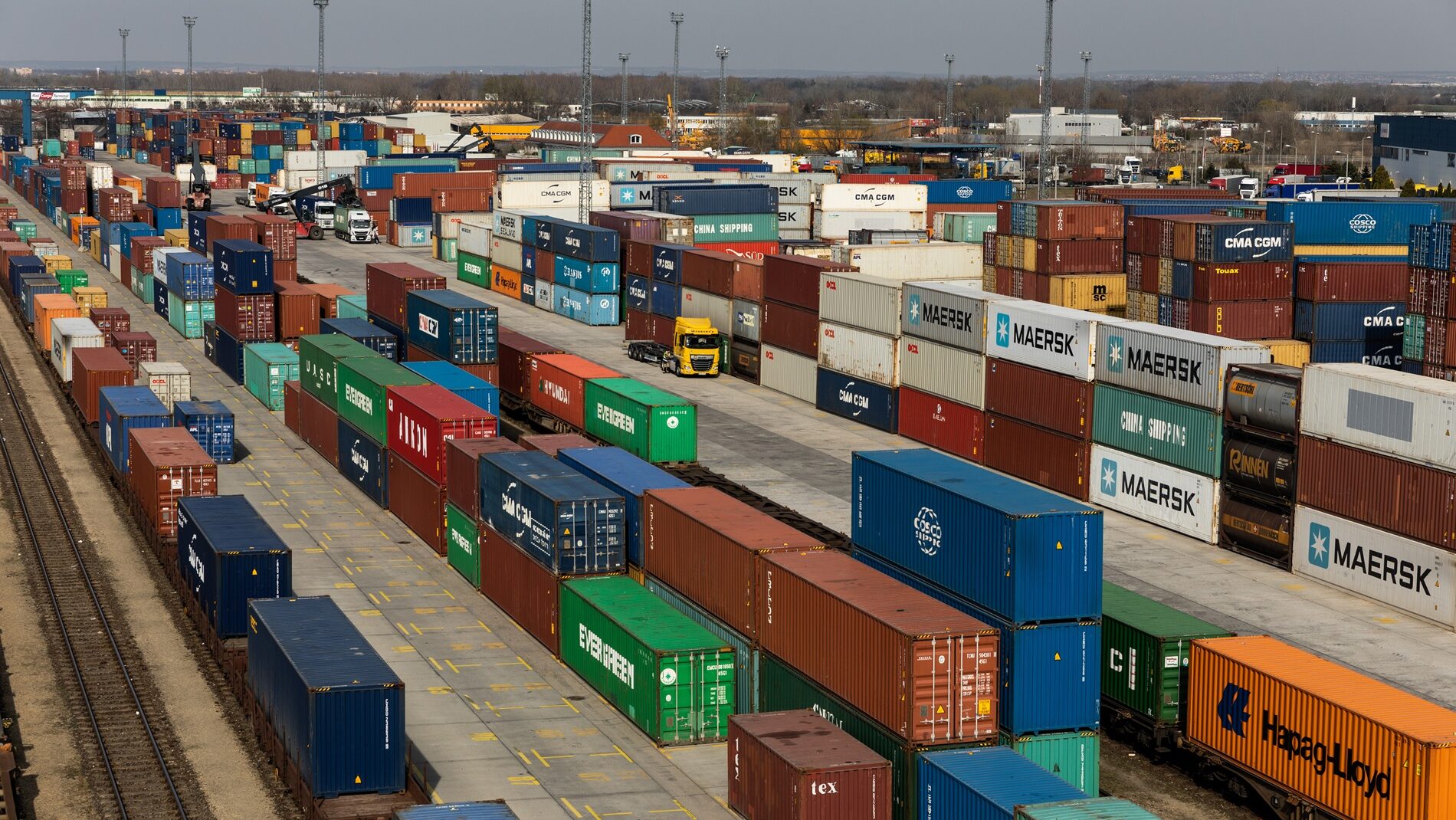
Logivest expects recovery in logistics real estate by the end of 2024
6. August 2024
Rhenus High Tech Participates in the Stuttgart Project REALIST
6. August 2024
The economist and computer scientist Sophie Parragh researches how to find better and more nuanced solutions for complex problems. To this end, she programs algorithms that can represent the sometimes contradictory goals in many areas of the economy, such as logistics or production.
(Wien) Making decisions is not always easy, especially when pursuing multiple goals. Computer programs can help by finding solutions to complex problems in fields such as production, logistics, and mobility. However, even for highly developed computer-based technologies, it has been difficult to find the best – the optimal – solutions so far. This is because hundreds or even thousands of variables must be considered.
Sophie Parragh, head of the Institute for Production and Logistics Management at Johannes Kepler University Linz, researched in her project funded by the Austrian Science Fund (FWF) “MOMIP: Multi-Objective (Mixed) Integer Programming” together with her team on new algorithms that are intended to solve a specific type of such optimization problems: mixed-integer problems with multiple different objectives that all need to be met as well as possible. “Many problems in the economy can be modeled as mixed-integer systems,” says the researcher. “These are mathematical models that encompass costs, resources, decisions, and much more.”
The application examples for these algorithms are diverse: for instance, they can minimize CO2 emissions in a production chain or find the optimal routes for shared electric mobility, which should keep waiting times for customers and noise pollution for residents as low as possible. Another example is the efficient planning of mobile care services. Here, it is not only important that there is enough time for care, but also that the desired caregivers and visiting times of the clients are taken into account.
Sophie N. Parragh researches the development of optimization methods for decision support in production and logistics. The project “MOMIP: Multi-Objective (Mixed) Integer Programming” (2018–2022) was funded by the Austrian Science Fund (FWF) with around 390,000 euros.
Defining Variables from Flexible to Fixed
The fact that the models are mixed-integer means that some variables in the model are continuous – meaning they can take any possible number – while others can only take specific whole numbers like zero or one. For example, the length of the approach route of a delivery service is a continuous variable, as the transporter can take detours of any length to avoid certain roads, thus making the distance longer. In contrast, the decision to establish a package distribution center is a discrete variable, as it can only be built completely (represented as “1”) or not at all (represented as “0”).
In addition to the mixed-integer variables, the second core aspect of the task that Parragh and her team address is to fulfill multiple objectives simultaneously. This presents special challenges for researchers but also allows for more nuanced solution approaches.
Algorithms with Multiple Objectives Can Find Optimal Solutions
“Established algorithms so far can primarily solve tasks with only one objective. Therefore, they can only find one optimal solution, which is not always helpful,” says Parragh. For example, in package delivery, a common goal is to keep transportation costs as low as possible. However, focusing solely on costs overlooks other objectives.
“Algorithms with multiple objectives, like ours, can find a set of optimal solutions that represent different compromises,” explains Parragh. “One solution may generate the lowest costs but cause more CO2 emissions. Another solution may cost a bit more but produce fewer emissions. And there are many other solutions in between.”
Room for Maneuver for Decision-Makers
As part of their project, the researchers sought a method that finds the optimal solutions for various types of complex problems. Approaches to the best solutions have already been found by established programs, but the goal of Parragh and her team is to create general algorithms that mathematically prove the optimal solutions for many different problem statements.
With the nuanced solutions produced by their programs, Parragh and her team aim to give decision-makers in business and politics more room for maneuver. “We have seen in our models that goals such as reduced emissions, environmental protection, or even higher customer satisfaction suffer when one focuses solely on cost optimization,” adds Parragh. “These goals can often be much better achieved if one is willing to incur slightly higher costs.”
Combinations of Variables
“In the problems we are working on, combinatorics comes into play. This means that the number of possible combinations of variables for different solutions increases enormously quickly, making it impossible to handle them simply,” explains the computer scientist. Together with her team – Nicolas Forget, Fabien Tricoire, Duleabom An, Markus Sinnl, and Miriam Enzi – and international cooperation partners, she developed so-called branch-and-bound algorithms.
In branch-and-bound methods, the set of all possible solutions – not just the optimal ones – is divided into smaller groups to examine them individually. The program can then decide more quickly whether the sought optimal solutions lie in one of these groups instead of examining all solutions at once.
If calculations show that the optimal solutions cannot lie in the examined group, the solutions within it are discarded. If the optimal solutions can be contained, the algorithm can further divide the group into even smaller groups and continue searching. With these branches, the program ultimately finds the optimal solutions that meet the specified goals with various compromises.
Parragh summarizes: “One of the milestones at the end of the project was that we developed an algorithm for systems with about a hundred integer decision variables and for three or even four objectives that can compete with other established methods. We are now working on further developing these programs.”
The Demand for Nuanced Solutions Will Not Cease
Even after the completion of the project “MOMIP: Multi-Objective (Mixed) Integer Programming” in September 2022, Parragh and her team continued their work. They refined their algorithms to model, for example, the risk awareness of decision-makers, explore new application fields, or make calculations more effective. Research teams can be confident that the demand for nuanced solutions to the problems of our complex society will not diminish in the future.
Sophie Parragh studied international business administration at the University of Vienna. As a postdoc, she researched at the IBM Center for Advanced Studies in Porto and subsequently held a position funded by the FWF as a Hertha Firnberg Fellow. After a visiting professorship at the Vienna University of Economics and Business, she habilitated in 2016 at the University of Vienna. Since March 2017, Sophie Parragh has been leading the Institute for Production and Logistics Management at Johannes Kepler University Linz.
Photo: © unsplash+ / Image Caption: Finding optimal routes while minimizing CO2 emissions and reducing noise pollution. Algorithms can provide decision support to best meet multiple objectives