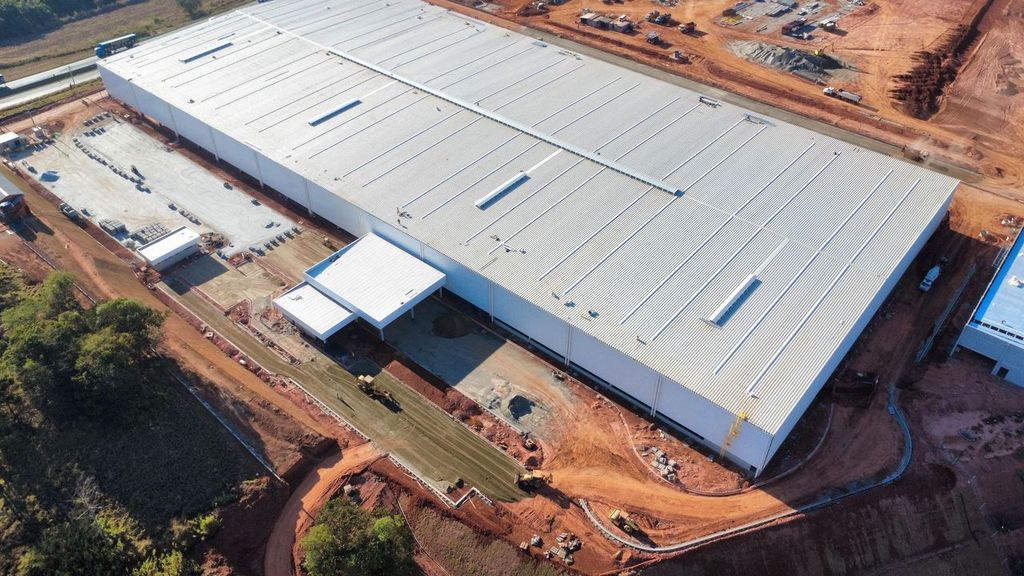
Logix presents three publications on logistics real estate
7. November 2024
TGW Logistics Equips Betty Barclay’s Logistics Center
7. November 2024
In addition to upgrading the German rail network, low track prices and innovations are essential to increase the competitiveness of rail freight transport. This was the unanimous demand of the experts at the DVF event for the Parliamentary Group on Rail Transport in the German Bundestag.
(Berlin) Valentin Abel MdB, Deputy Chairman of the Parliamentary Group on Rail Transport in the German Bundestag, stated that the planned market share of rail freight transport of 25 percent by 2030 depends on reliable planning, long-term financing of infrastructure, and competitive track prices. “Some measures have already been initiated. I am thinking of the promotion of rail connections and the general renovation. In addition to a reliable infrastructure, innovations such as automation and digitalization are necessary: for cross-border rail freight transport, equipping the TEN-T with ECTS is particularly important.”
Prof. Dr. Corinna Salander, Head of the Railway Department at the Federal Ministry for Digital and Transport, also stated that a reliable digitized rail network is necessary for the competitiveness of rail freight transport. The Master Plan for Rail Freight Transport includes 66 measures in implementation, aimed at improving infrastructure capacity, network access, modernization, innovation, and promoting rail freight transport. A European funding program for the Digital Automatic Coupler (DAK) needs to be developed, supported by national funding programs. Furthermore, the Federal Ministry of Transport is working hard to equip the rail network and vehicles with the European Train Control System (ETCS). The government draft for the federal budget 2025 includes funding programs amounting to 726 million euros. Of this, 275 million euros are allocated for track price promotion and 300 million euros for promoting single wagon traffic as the largest item. Above all, the Federal Ministry of Transport aims to reform the regulations of the track pricing system. A focus of the Modern Rail Law is the reduction of the equity return of DB InfraGO AG, which will affect a reduction in track prices.
Preventing the Weakening of Rail Transport First
“Before we talk about strengthening rail freight transport, we must prevent its weakening,” said Bernd Riexinger MdB, Deputy Chairman of the Parliamentary Group on Rail Transport in the German Bundestag. “Either the increase in track prices is prevented, or rail freight transport receives an increase in track price promotion. Strengthening rail freight transport requires a whole bundle of measures such as lowering the electricity tax, promoting the digital automatic coupler, and above all, a better network on which more rail freight services can operate.”
Dr. Martina Niemann, Board Member for Finance and Controlling as well as Offer Management at DB Cargo AG, addressed the situation of single wagon traffic and the European state aid procedure against the Federal Republic of Germany, as the previous regulation is no longer permissible: “The solution is now a modified funding concept that aims to open the federal funding of 300 million for single wagon traffic to the entire industry. So far, 69 companies have applied for it, and initial approvals have already been granted. DB Cargo has received 40 million euros so far; other transport companies around 50 million. The purpose of this funding is to compensate for the systemic disadvantage compared to trucks.” Niemann also advocated for revising the track pricing system, as otherwise, track prices would continue to rise and create a competitive disadvantage.
From the perspective of a private company, Armin Riedl, Managing Director of Kombiverkehr GmbH & Co. KG/Lokomotion Gesellschaft für Schienentraktion mbH, described the competitive problems of rail freight transport in daily practice: “Especially the closures of the corridors towards Austria and Italy, along the Danube and to Brenner, are more than challenging for private freight railways due to the detours of up to 800 km, and for some, they are existentially threatening. The federal government is obliged to provide compensation here, especially for the Brenner approach. No one would think of closing the highways without replacement. And it helps no one if we later have a good network but no companies left to operate on it.”
Implementing Unfinished Projects
For the designated EU Transport Commissioner, rail transport is an important issue, reported Kathrin Obst, Deputy Head of the Single European Rail Area Unit, DG MOVE European Commission. He also wants to implement the unfinished projects from the last legislative period and advance the implementation of TEN-T. Obst expressed a desire for a harmonized European railway area. For this, member states must consider cross-border traffic more in their planning. The networking would accelerate significantly if member states could agree on technological standards and forgo national special requests.
Photo: © DVF / Image Caption (l.r.): Moderation: Susanne Landwehr, DVZ; Dr. Martina Niemann, Board Member for Finance and Controlling as well as Offer Management, DB Cargo AG; Bernd Riexinger MdB, Deputy Chairman of the Parliamentary Group on Rail Transport in the German Bundestag; Prof. Dr. Corinna Salander, Head of the Railway Department at the Federal Ministry for Digital and Transport; Dr. Heike van Hoorn, DVF Managing Director; Kathrin Obst, Deputy Head of the Single European Rail Area Unit, DG MOVE European Commission; Valentin Abel MdB, Deputy Chairman of the Parliamentary Group on Rail Transport in the German Bundestag; Armin Riedl, Managing Director, Kombiverkehr GmbH & Co. KG /Lokomotion Gesellschaft für Schienentraktion mbH