






Mercedes-Benz Trucks with Additional Fast Charging Stations in Wörth
16. November 2024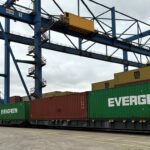
HGK connects Duisburg and Rotterdam with clever ‘SchachZUG’
16. November 2024
The container throughput in the Port of Hamburg remained almost at the same level in the first nine months of 2024 compared to the previous year, with 5.8 million TEU. The handling of loaded containers increased slightly. Conventional breakbulk cargo was also handled more frequently.
(Hamburg) “The rail transport, which is so important for sustainable transport, has also developed positively in the first nine months. As the largest railway port in Europe, we place great importance on expanding rail services. Thus, the transport of containers in this area increased by 2.7 percent, and the total tonnage on the rail also showed positive results for the Port of Hamburg,” says Axel Mattern, Managing Director of Port Hamburg Marketing (HHM).
Despite these developments, the weak German economy continues to be reflected in the overall throughput of the port. Additionally, the tense political conditions due to the war in Ukraine and the attacks by Houthi militias in the Red Sea have contributed to this. Overall, the total seaborne cargo throughput decreased by 3.0 percent, amounting to 84.0 million tons from January to September 2024.
Container Throughput with Mixed Results
With 5.1 million TEU, the throughput of loaded containers grew by 0.2 percent compared to the previous year. In contrast, the throughput of empty containers fell by 4.6 percent to 722,000 TEU. Overall, the container throughput stands at 5.8 million TEU (-0.4 percent). Accordingly, the tonnage-based container throughput is at 58.2 million tons (-0.1 percent), almost at the same level as the previous year. Due to temporary ship reroutings around the Cape of Good Hope, western ports were increasingly used as transshipment hubs for Asia-Mediterranean volumes. Hamburg did not benefit from this positive effect in container throughput.
A positive signal came again from the segment of conventional breakbulk. This area, with high value creation potential, grew by 3.7 percent to 904,000 tons.
Bulk Cargo Still Uneven
Throughout the year, the bulk cargo throughput in the Port of Hamburg showed a slight recovery. After the first nine months, it stood at 24.9 million tons (-9.3 percent). At mid-year, the decline was at 12.1 percent. The decrease in coal throughput due to the shutdown of some power plants continued to be noticeable. Overall, the handling of grab cargo is at 13.5 million tons (-7.7 percent). For suction goods or agribulk, with a throughput of 4.8 million tons (-4.1 percent), the export of animal feed stood out positively with 1.0 million tons and an increase of 7.8 percent. The import of oilseeds also improved by 2.8 percent to 2.3 million tons. A similarly positive picture is seen in the export of mineral oil products, with a throughput of 1.3 million tons and an increase of 34.6 percent. However, the overall throughput of liquid cargo decreased by 15.6 percent to 6.6 million tons.
 Ranking of Trading Partners Stable
Also, from January to September 2024, China remains the strongest partner country in terms of throughput with 1.6 million TEU. The USA continues on a growth path. The second strongest partner country increased by 7.6 percent to 520,000 TEU. Trade with Brazil also rose by 2.6 percent to 124,000 TEU. Mexico also showed positive results with an increase of 3.5 percent and a throughput of 81,000 TEU. Furthermore, the seaborne trade with Poland (4th place) increased by 16.0 percent to 232,000 TEU, and Malaysia (9th place) with 144,000 TEU and an increase of 29.8 percent also performed well.
The number of ship calls with capacity for container cargo in the Port of Hamburg was 0.3 percent above the previous year’s value in the first three quarters of the year. Medium and small ship sizes developed positively.
Rail Transport Stands Out in Hinterland Traffic
Rail-bound container transport in the seaport hinterland traffic grew by 2.7 percent in the first nine months of this year, reaching 2 million TEU. The total tonnage also remains positive over the year with 35.1 million tons, corresponding to a growth of 1.4 percent. “The figures demonstrate how efficient the environmentally friendly transport mode of rail is. Despite adverse weather conditions and technical and personnel challenges, rail remains on the path to success,” emphasizes Mattern.
Photo: © HHM / Hasenpusch Productions
Graphic: © HHM


