







Gebrüder Weiss acquires majority stake in Sienzi in Turkey
4. September 2025
SBB Welcomes BAV Directive Following Accident in Gotthard Tunnel
14. September 2025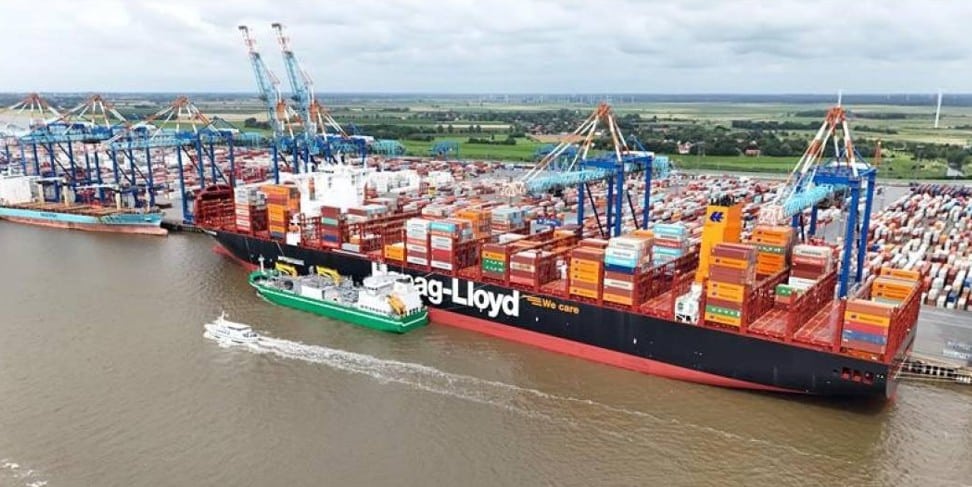
Shell Western LNG B.V. (Shell) and Hapag-Lloyd have signed a multi-year agreement for the supply of liquefied biomethane – also known as Bio-LNG. Deliveries to the global liner shipping company have already begun. The partnership builds on a strategic collaboration initiated in 2023 to accelerate the development of alternative, climate-friendly marine fuels.
(Hamburg) Biomethane plays a crucial role in Hapag-Lloyd’s climate strategy, which aims for a climate-neutral fleet operation by 2045. The use of biomethane enables significant emissions reductions and helps customers make their supply chains more sustainable. Since 2024, Shell has been offering liquefied biomethane and provides it through its global LNG bunkering network at 22 strategic locations.
“This agreement secures the necessary supply reliability and consistency we need to further expand the use of waste-based, renewable fuels in our fleet – without compromising on quality and reliability, as our customers expect. Partnerships like this demonstrate that those who want to lead in shipping must act now – with lower-emission fuels that are already available today, rather than waiting for future solutions,” says Jan Christensen, Senior Director Global Fuel Purchasing Hapag-Lloyd AG.
Dexter Belmar, Vice President Global Downstream LNG at Shell, adds: “Bio-LNG is no longer a vision for the future – it is a reality and is driving the next phase of decarbonization in shipping. These long-term contracts help build the trust necessary for scaling renewable fuels.”
The liquefied biomethane supplied to Hapag-Lloyd is certified according to ISCC EU. This certification ensures the sustainability of raw material sourcing, traceability along the supply chain, and credible and verified reductions in lifecycle emissions.
Switching to Renewable Fuels Without Technical Adjustments
Biomethane is a so-called “drop-in” fuel that allows Hapag-Lloyd’s LNG dual-fuel ships to switch to renewable fuels without technical adjustments. The biogas is produced from the decomposition of organic waste such as crop residues, manure, and food waste, processed into biomethane, and then liquefied. It is fed into the local gas grid and delivered to the ships based on a mass balance.
Photo: © Hapag-Lloyd


