






CTL Expands Area at Central HUB in Homberg
18. November 2025
Liebherr Delivers Port Crane to Nuh Çimento at Hereke Port
20. November 2025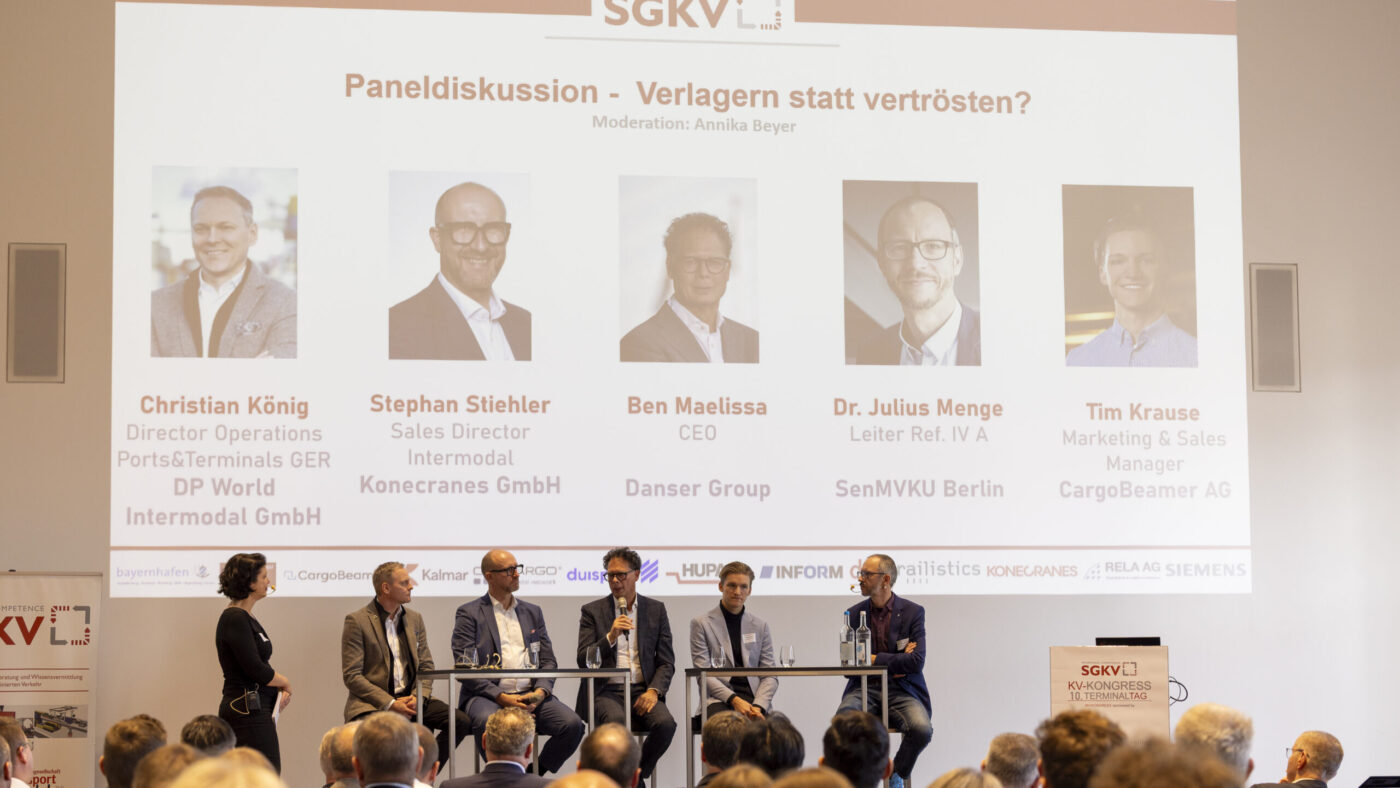
The KV Congress of SGKV has established itself as a central networking platform for stakeholders along the intermodal value chain. Around 140 representatives from business, politics, and science met on November 12 and 13 in the capital to discuss current challenges and opportunities in intermodal transport.
(Berlin) The participants of the KV Congress agreed that Combined Transport (KV) is and remains the driving force in rail freight transport, but the framework conditions for its maintenance and further development are critical. Rising costs and disruptions in operational processes hinder the strengthening of KV; however, the motivation of the industry remains unbroken. What is missing is a stronger political orientation towards further shifting traffic to rail and inland waterways. This is also evident in the increasingly critical funding for KV, which represents an important pillar for the terminal network in Germany and will be far below the expected demand in the future, as shown by Clemens Bochynek (SGKV e.V.).
The KV Congress was opened with a pre-event program that particularly provided space for intensive networking. The content was kicked off by two strong keynotes from the operational KV business and politics – delivered by Michail Stahlhut, CEO of the HUPAC Group, and Tarek Al-Wazir, Member of the Bundestag (Alliance 90/The Greens) and Chairman of the Transport Committee of the German Bundestag. Both speakers called for commitment to the more environmentally friendly transport alternative KV and discussed the needs and obstacles for targeted measures in freight transport.
At the beginning of the second day, Thore Arendt (Railcampus OWL e.V) highlighted the necessity of further promoting innovations and political commitment for KV and strengthening the networking approach of SGKV in his impulse for the 10th anniversary of the KV Congress of SGKV.
Perspective of the Berlin Senate Administration on Combined Transport
In his keynote, Dr. Julius Menge, Head of Department IV A for Fundamental Issues of Mobility Policy and Transport Development Planning of the SenMVKU Berlin, provided insight into the perspective of the Berlin Senate Administration on Combined Transport – particularly in the urban context. He emphasized the importance of logistical areas and highlighted that KV plays a central role in supplying the capital.
Dr. Ralf Bammerlin, Head of Department G14 at BMV, referred to the current challenges for the entire intermodal transport industry due to rising track prices and restrictions caused by construction situations in the rail network. The BMV continues to support Combined Transport in a targeted manner, particularly through the KV funding guidelines, which will be extended for another year until the end of 2027. Regarding the necessary increased allocation of budgetary funds for the funding guidelines, he pointed to direct discussions in the parliamentary framework.
The subsequent panel discussion, moderated by Annika Beyer (SUT), with participation from Christian König (DP World), Ben Maelissa (Danser Group), Stephan Stiehler (Konecranes), Tim Krause (CargoBeamer), and Dr. Julius Menge (SenMVKU Berlin), focused on the challenging framework conditions – including numerous train delays and observable shifts back to road transport. At the same time, there was consensus among the discussants: KV has a strong product and is a particularly environmentally friendly transport alternative. Now, it is important to make these advantages even more visible and to create pragmatic solutions together to address the current issues.
Expert Lectures and Awards
In five expert lectures, further approaches from the field of intermodal transport chains were highlighted: the development of digital solutions to support port and KV terminal-related processes by dbh, akquinet, and Inform, the acquisition of new markets for KV by InnoWood, and planning support for KV transport with construction-related process restrictions by TU Dortmund.
Additionally, numerous start-ups demonstrated their innovation potential in the “Innovation Pitch” and presented sustainable and efficient solutions. BOOXit OG was awarded for their innovative solution for modular stacking box systems for logistics.
Combined Transport is a Central Building Block
The 10th KV Congress made it clear: Combined Transport is a central building block of performance in freight transport. Despite current challenges, KV is attributed a crucial role for the coming years. The industry is determined to actively promote KV – provided that the necessary political support is strengthened to shift more and delay less. Because here too, it holds true: KV only works together!
Photo: © Aya Schamoni/SGKV


