duisport and LBC Tank Terminals plan new terminal
30. November 2025
Leadership change announced at deugro USA
2. December 2025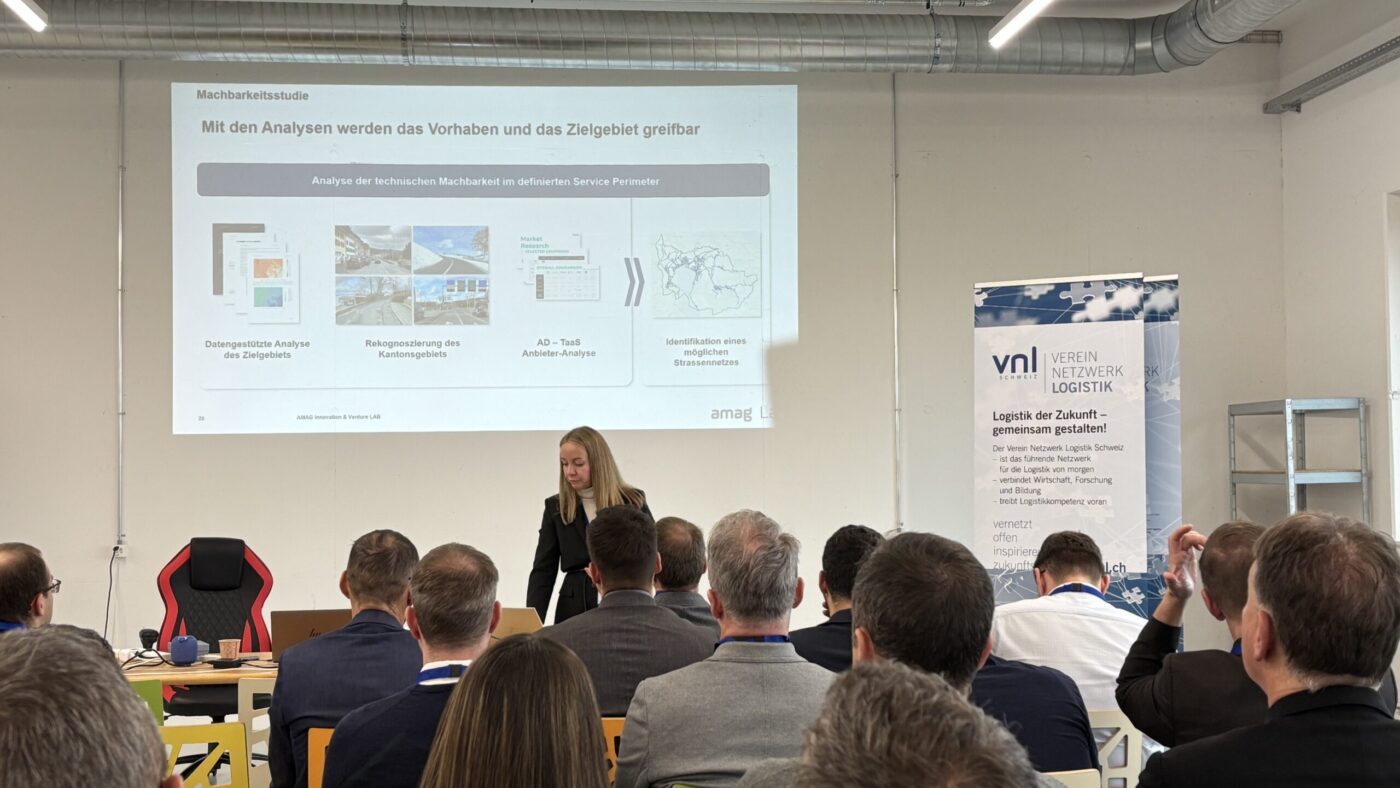
Last week on November 25, logistics experts gathered for the Swiss Logistics Innovation Day in Zofingen. Around the theme “Autonomous Logistics through Networking,” the Swiss Logistics Network Association (VNL) presented a packed day of innovation at the Swiss Logistics Campus, focusing on digitalization, automation, and data-driven planning.
(Zofingen) The wide range of presentations at the Swiss Logistics Innovation Day of VNL Switzerland in Zofingen impressively demonstrated how rapidly technology and value creation networks are changing – and how strongly the industry demands interoperable, secure, and sustainable solutions.
Autonomous Logistics: From Vision to Operation
Right at the beginning, the keynote by Anna Chirkova (AMAG Innovation & Venture LAB) set a clear signal: autonomous freight transport is becoming a reality. Since March 2025, Switzerland has a stable legal framework for automated driving, known as the VAF regulation. This opens up new possibilities for projects ranging from drones to urban RoboVans to long-term hub-to-hub transports. First vehicles are expected to be type-approved and available from 2026/27. It was particularly emphasized that the main issue is not the autonomous vehicle technology – but the transformation of existing logistics processes, especially at loading and unloading points.
The scenarios showed that automated fleets can stabilize processes, increase availability, and operate CO₂-neutrally in the long term. The driver shortage, which is expected to worsen dramatically according to forecasts, could also be mitigated. At the same time, AMAG illustrated through pilot projects the enormous potentials, but also the necessary adjustments in organization, planning, and infrastructure.
Digital Twins: Decision Quality Instead of Gut Feeling
In the second keynote, Roland Michaely (Dassault Systèmes) demonstrated how digital twins in transport networks, warehouses, or production environments lead to faster decisions and safer processes. Fragmented IT landscapes and data silos remain the biggest obstacles. Digital twins create a “virtual sandbox” where companies can simulate scenarios, mitigate risks, and plan CO₂-optimized networks.
Interoperability, Data Flows, and Planning Intelligence
The subsequent impulse block further emphasized networking, data management, and automation:
Oliver Gaede (OGIL) showed that over 120 TMS systems are in use in Switzerland – and the number of interfaces thus runs into the thousands. A significant loss of efficiency arises solely from the lack of data permeability. According to his calculations, just ten seconds of efficiency gain per order could save up to CHF 10 million annually.
Dr. Alexander Souza (Algomia) presented a different perspective on optimization: fully automated planning of crew and resource deployment using mathematical models. Algomia has already implemented this nationwide in rail transport – with billions of variables in the models and enormous efficiency gains. Planning that used to take months can now be executed in a few days or minutes, including strategic simulations and scenario building.
Erik Fischer (BITO) demonstrated with the concept “Internet of Bins” how reusable containers become intelligent, connected nodes. Smart labels with e-ink displays and sensors enable real-time tracking, pick-by-light, paperless processes, and automated replenishment signals. This closes the gap between goods flow and information flow – a central step towards an autonomous supply chain.
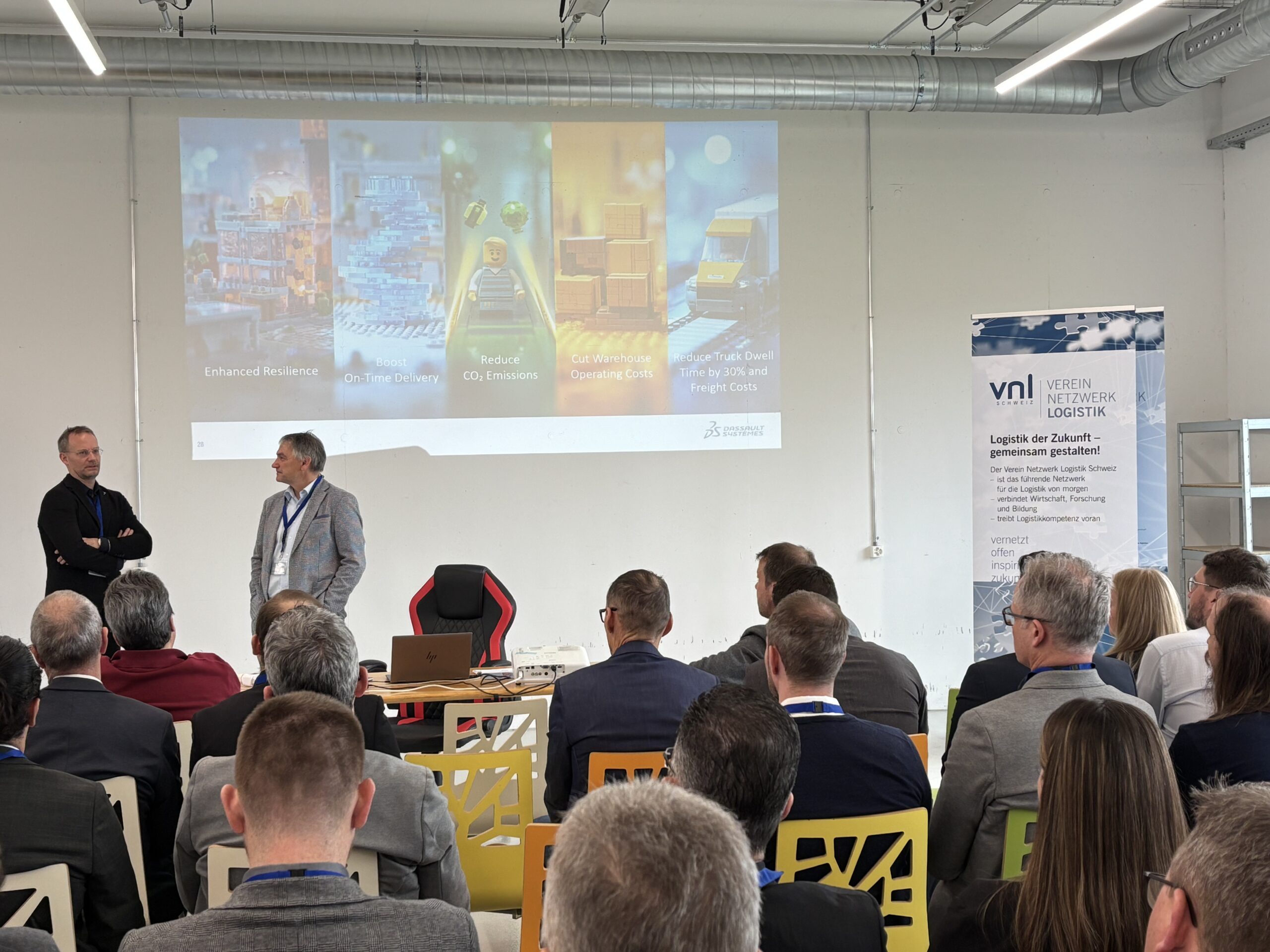
Herbert Ruile (right), President of the Logistics Network Association (VNL) in conversation with keynote speaker Roland Michaely, Sales Director Switzerland, Dassault Systèmes
Intermodal Future, Complex Supply Chains, and Fast Picking
Looking at the large traffic flows between Switzerland, Italy, and Europe, Gianpiero Mattei and Matteo Salani (SUPSI) showed how logistics networks are evolving from static, linear structures to hyper-connected, AI-supported ecosystems. The focus was on the SWITCH project, which aims to provide tools and platforms for synchromodal, dynamic transport planning – including digital twins and AI-based routing algorithms. The goal is an open, flexible “Physical Internet” for the region.
Markus Ly (Westernacher) outlined the increasing complexity of global value chains. Personnel, machinery, and transport bottlenecks meet volatile demand, geopolitical risks, and financial conflicts of interest. Integrative planning approaches – for example, using SAP IBP – synchronize tactical, operational, and financial elements of the supply chain. The goal: to plan more transparently, agilely, and resiliently and to enable data-driven decisions across the entire organization.
The impulse block concluded with Dr. Josef Haid, founder and CEO of Pick&Ship Technology AG, on the topic: “Robotics Meets Supply Chain – Automating with Mobile Robots, Smart Containers, and AI.” Participants could see this in practice, as an employee demonstrated how easy picking can be with Pick&Ship.
A Day Focused on Networking
In the afternoon, four teams formed with two topics each for workshops that provided inputs on the day’s theme. In brainstorming sessions, theses were developed and then presented to the other participants.
The Swiss Logistics Innovation Day 2025 impressively showcased how deeply Swiss logistics has already engaged with topics such as autonomous systems, digital twins, IoT infrastructures, and AI-based optimization. At the same time, it became clear that the transition to the connected, automated logistics of tomorrow requires not only technology but, above all, harmonized data models, interoperable systems, and collaborative action.
Photos: © Loginfo24 / Caption: Anna Chirkova,