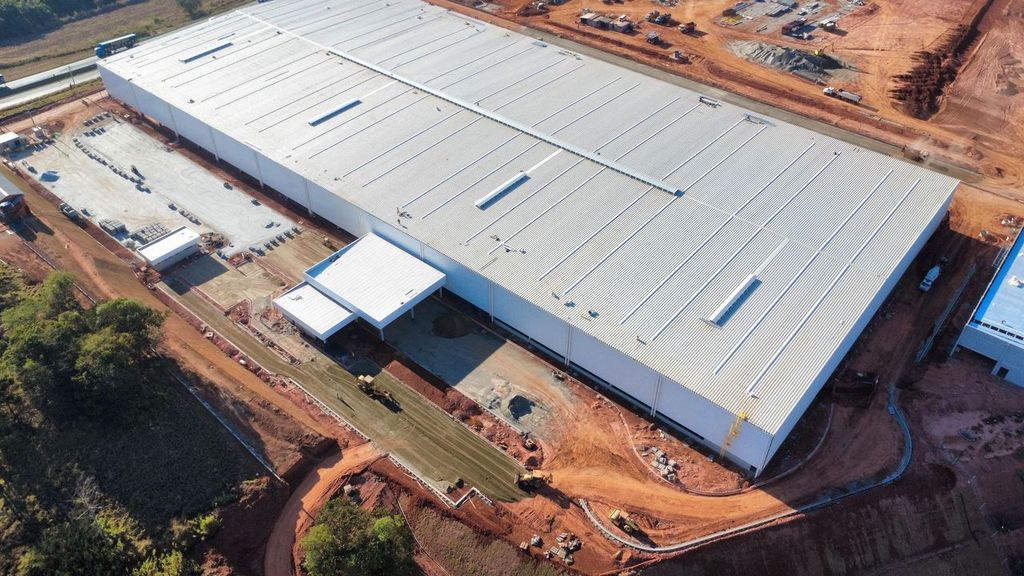
Garbe Industrial Real Estate Logistics Area in Kaiserslautern
17. June 2020The BVL Logistics Indicator Points to a Prolonged Economic Crisis
17. June 2020At the general meeting of the Swiss rail operator Hupac, long-time CEO Beni Kunz was appointed to the board of directors. Michail Stahlhut will succeed him. Erich Staake, chairman of the duisport AG, was also elected to the board. The results for 2019 are satisfactory, and the company is well-positioned for the current year, able to withstand the crisis.
(Chiasso) With the decision of the parliament to extend the promotion of combined transport through the Alps until 2030 and to significantly increase the amounts compared to the government’s proposal, Switzerland is sending a clear signal in favor of shifting transport. The EU Mobility Pact, on the other hand, will weaken international combined transport in Europe. In the current Corona crisis, Hupac welcomes the measures planned by the Federal Office of Transport to maintain intermodal transport networks. Despite COVID-19, Hupac is looking ahead: Erich Staake and Beni Kunz were newly elected to the board, while Michail Stahlhut was appointed CEO of the Hupac Group.
Setting the Course for the Future
The general meeting of Hupac AG took place for the first time on June 12 without the presence of shareholders due to COVID-19 restrictions. Through a proxy, the shareholders approved a satisfactory annual financial statement for 2019. Additionally, they strengthened the board by electing two new members. Erich Staake (66), chairman of duisport AG, has developed the Duisburg location into a significant platform for trimodal logistics in Europe and an important hub for Silk Road traffic. His extensive experience in intermodal transport – particularly overland to and from China – will provide Hupac with new impulses in this growing market. Newly elected to the Hupac board was also Beni Kunz (62). After 16 years of successfully leading the group, he is handing over the operational management to younger hands. In his new role as Executive Board Member, he will support Hupac in strategic projects and thus significantly contribute to the company’s development in the coming years. The board also appointed Michail Stahlhut (52) as the new CEO of the Hupac Group. After his two-year introductory period as CEO of the subsidiary Hupac Intermodal, which operates the continental traffic of the Hupac Group, he is well acquainted with the business. “With this change in leadership, we are taking an important step for the future of our over 50-year-old company,” emphasizes board chairman Hans-Jörg Bertschi.
Investment Security 2030
The extension and increase of funding creates an important basis for continuing the shift in transport in Alpine transit. The operating contributions to the operators of combined transport through Switzerland were originally set to be discontinued by the end of 2023. However, since the expansion of the northern access routes to the base tunnels is delayed by at least a decade, combined transport on this axis cannot yet realize the productivity necessary for a cost-covering, competitive offer. In early June, the Swiss parliament decided to continue the funding until 2030 and to increase it by CHF 385 million. This is significantly more than the CHF 90 million requested by the government until 2026. However, compared to the current funding level, this means a halving of the funding. This development will require all participants in the combined transport chain to achieve further productivity increases. Thus, the parliament has adopted a significantly more shift-friendly solution than originally proposed by the Federal Council. “An important signal for the market,” explains Hans-Jörg Bertschi. “Switzerland consistently advocates for the shift in transport. This gives the involved companies the security that investments in environmentally friendly combined transport will continue to be worthwhile.”
Mobility Package Compromise Weakens Combined Transport
Among the central framework conditions for combined transport is also the fair regulation of the pre- and post-haulage by road. Since 1975, international combined transport in the EU has been equated with international road freight transport, as national road cabotage rules do not apply in either case. With the mobility package compromise, which is to be adopted by the EU Parliament in early July, combined transport will be disadvantaged compared to international road transport. The mobility package will allow member states to apply cabotage rules to national pre- and post-haulage for combined transport in the future. “This will significantly weaken combined transport in Europe and could jeopardize the Green Deal. The exemption of pre- and post-haulage from cabotage rules should remain mandatory to prevent a disadvantage for combined transport compared to road transport. We hope that the EU Commission will make changes in favor of climate and environmental protection,” comments Hans-Jörg Bertschi.
Corona Crisis Shapes Development in 2020
As a result of the Corona crisis, Hupac expects a significant drop in volume for the current year. After a positive first quarter, transport demand collapsed in April – this was due to the Europe-wide lockdown and the special situation in Italy, where even the industry was shut down for three weeks. Although a recovery is currently emerging, the traffic losses for Hupac will be significant by the end of the year.
Continue the Shift and Survive the Corona Crisis
Despite these precautions, the pandemic-related drop in traffic has significant impacts on the network of Hupac and other operators, especially in the Italy traffic. Due to lower demand, the utilization of trains decreases, and departures must be canceled. The losses for operators in combined transport through Switzerland will significantly impair the ability of the players to act in the future. The resulting deficits can hardly be borne by the players in combined transport on their own, says Hans-Jörg Bertschi: “Without appropriate countermeasures, we risk that the shift in transport will be set back by years.” Hupac therefore welcomes the initiative of the Swiss parliament to compensate for part of the COVID-19-related losses in public transport to maintain the offer for the post-crisis period.
Combined Transport Dependent on Infrastructure Expansion
Measures to support environmentally friendly rail freight transport have also been taken by Italy, Germany, and Austria. “In some cases, this is unfortunately just a drop in the bucket,” warns Michail Stahlhut, CEO of Hupac. “Without partial compensations, the operators of combined transport are forced to reduce their offerings, which would trigger a dangerous downward spiral in the shift of transport.” In a long-term view, however, combined transport has excellent prospects to contribute to the success of the European Green Deal. In the Hupac Group’s network alone, 1.5 million tons of CO2 were saved in 2019 – with a transport volume of over one million road consignments – compared to pure road transport. A central prerequisite for the success of combined transport is the expansion of rail infrastructure to a train length of 750 meters and profile P400. The importance of generous rail capacity dimensions has been demonstrated during the Corona crisis: “During the crisis-related reduction of passenger transport, our trains were finally able to operate again with good punctuality values,” says Stahlhut. Photo: © Hupac www.hupac.com