Element Logic and Addverb Join Forces in Intralogistics
14. November 2023
FREIGHT RAILWAYS Highlight Signal Box Crisis in Germany
14. November 2023
Willem-Alexander, King of the Netherlands, visited Duisburg Port today. He acknowledged the efforts of duisport, in collaboration with the Port of Rotterdam and numerous other partners, to rapidly develop a Europe-wide hydrogen network. The royal visit to duisport was part of a trip through North Rhine-Westphalia, to which Minister-President Hendrik Wüst had invited him.
(Duisburg) “Here in Duisburg, it is evident how providers, users, and political actors are pulling together to develop concrete solutions for a sustainable path of hydrogen production and utilization. Only in this way can we make a significant contribution to activating the market and accelerating the energy transition,” emphasizes duisport CEO Markus Bangen.
The agenda included insights into various companies and institutes in the region, allowing the King of the Netherlands to personally and on-site learn about the status of current hydrogen projects. In addition to Duisburg Port, the delegation also visited the Chemical Park Marl and the research institute Center for Fuel Cell Technology (ZBT) in Duisburg.
The King and the Minister-President were accompanied by Mona Neubaur, NRW Minister for Economic Affairs, Industry, Climate Protection, and Energy, Dr. Philipp Steinberg, Head of Economic Policy at the Federal Ministry for Economic Affairs and Climate Protection, and Hans Vijlbrief, Secretary of State for Raw Materials Industry in the Dutch Ministry of Economic Affairs and Climate Protection.
Premiere at Rheinkai: First Ammonia Delivery from Rotterdam
At Rheinkai North in Duisburg-Hochfeld, the delegation witnessed a premiere: The first ship carrying low-carbon ammonia arrived via the planned hydrogen corridor from the Port of Rotterdam to Duisburg. This delivery is part of a unique global pilot project for the production of MMA – an important precursor for PLEXIGLAS®, used in cars, airplane windows, and screens, which utilizes ammonia. The ISCC-certified bio-ammonia from OCI Global, which was delivered to Duisburg for the first time in time for the visit of the Dutch King, is produced using biomethane from landfills, sewage sludge, and wastewater treatment plants. This allows for a reduction in the use of fossil fuel-based liquefied natural gas (LNG), which is typically used in conventional ammonia production. The result is a reduction in greenhouse gas emissions of more than 70 percent compared to conventional gray ammonia production.
In the future, ammonia is to be used primarily as an ideal hydrogen storage and energy carrier. It is not only more energy-efficient than transporting hydrogen, but ammonia can transport larger amounts of energy over long distances in less space. Duisport and the Port of Rotterdam aim to take a leading role in developing European hydrogen transport chains to meet the growing demand from industry for hydrogen and its derivatives, as well as to mediate between politics, industry, and future players in the hydrogen market. By 2027, a first pipeline is to be completed as part of the Delta-Rhine-Corridor (DRC) project to meet the growing demand for green hydrogen in North Rhine-Westphalia.
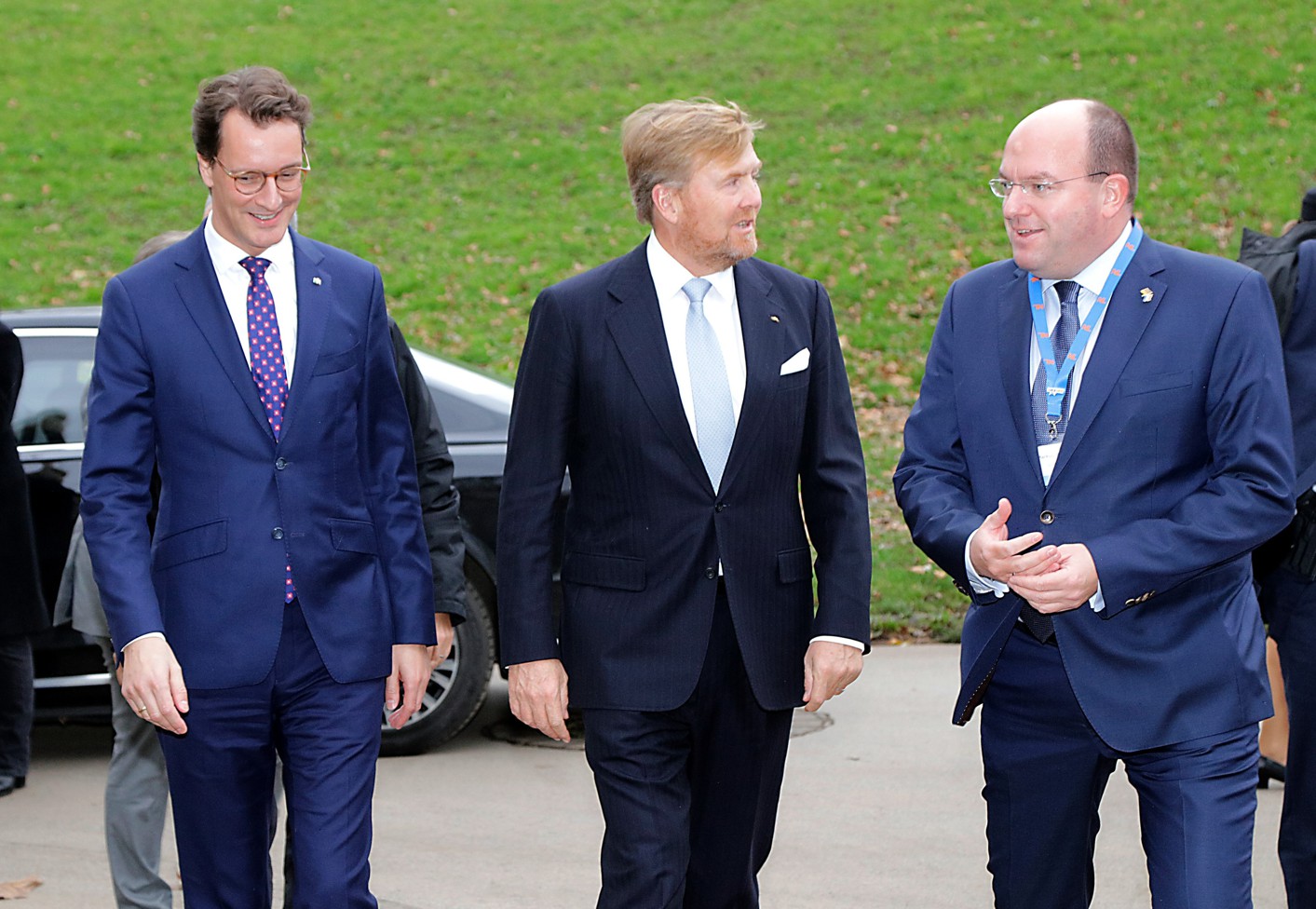 (l. to r.): Minister-President Hendrik Wüst, King of the Netherlands, Willem-Alexander, and duisport CEO Markus Bangen on a tour of Duisburg Port
Companies that are not connected to a pipeline or do not require full shiploads rely on supply through a tank or container storage, which is ideally connected in a trimodal manner and embedded in a strong rail and road network. Accordingly, new storage capacities are needed to provide the necessary products to the industry. To this end, duisport and Koole Terminals B.V., a Dutch developer and operator of liquid bulk terminals, are planning the development of a tank storage facility for liquid renewable fuels and raw materials such as ammonia in Duisburg Port. The site chosen for this future location is the property at Rheinkai North in Duisburg-Hochfeld, which King Willem-Alexander and Minister-President Wüst were able to inspect during their boat tour.
“Significant Contribution to Accelerating the Energy Transition”
Markus Bangen: “By developing robust transport chains between the West Ports and thus concrete solutions for a sustainable path of hydrogen production and utilization, we, together with the Port of Rotterdam, are making a significant contribution to activating the market and accelerating the energy transition. Today’s presentation underscores the importance of partnerships and proves that transport chains are already functioning today. Now it is about expanding capacities and building the necessary infrastructure.”
Following the tour, duisport, the Port of Bilbao, and the Port of Amsterdam, in the presence of King Willem-Alexander and Minister-President Hendrik Wüst, signed a letter of intent at the H2 Connecting Event together with the energy agency of the Basque government, Petronor, Evos Amsterdam, and Zenith Energy Terminals. The aim is to explore the development of an intra-European corridor for renewable hydrogen.
The letter of intent builds on an agreement made earlier this year between Bilbao and Amsterdam. According to this agreement, a viable corridor is to be established that enables the export of renewable hydrogen and hydrogen derivatives produced in the Basque Country to the Port of Amsterdam. With the involvement of duisport, the corridor plans are now being expanded so that Basque hydrogen could also be delivered directly to large industrial consumers in the Rhine-Ruhr region.
The transport and distribution of renewable hydrogen are an important part of a functioning supply chain between the ports of Amsterdam and Duisburg. For this purpose, duisport also signed a Joint Study Agreement (JSA) with the Port of Amsterdam at the H2 Connecting Event – with the specific aim of realizing a resilient supply chain. Factors such as technical and financial requirements, transport modalities, and infrastructure are to be evaluated.
Only in Collaboration Can We Tackle Global Challenges
As early as June of last year, duisport and the Port of Amsterdam announced their intention to expand their long-standing collaboration. To underscore their organizations’ commitment to these common goals, both CEOs signed a letter of intent. The JSA is a result of this work. duisport CEO Markus Bangen: “Only in collaboration can we tackle global challenges such as the energy transition and rapidly develop a Europe-wide hydrogen network.”
Photos: © krischerfotografie / Caption (l. to r.): Minister-President Hendrik Wüst, King of the Netherlands, Willem-Alexander, and duisport CEO Markus Bangen