






Hyster Launches New Generation of Lithium Forklifts
4. August 2024
PrimeVision with Tips for a Sustainable Warehouse Operation
4. August 2024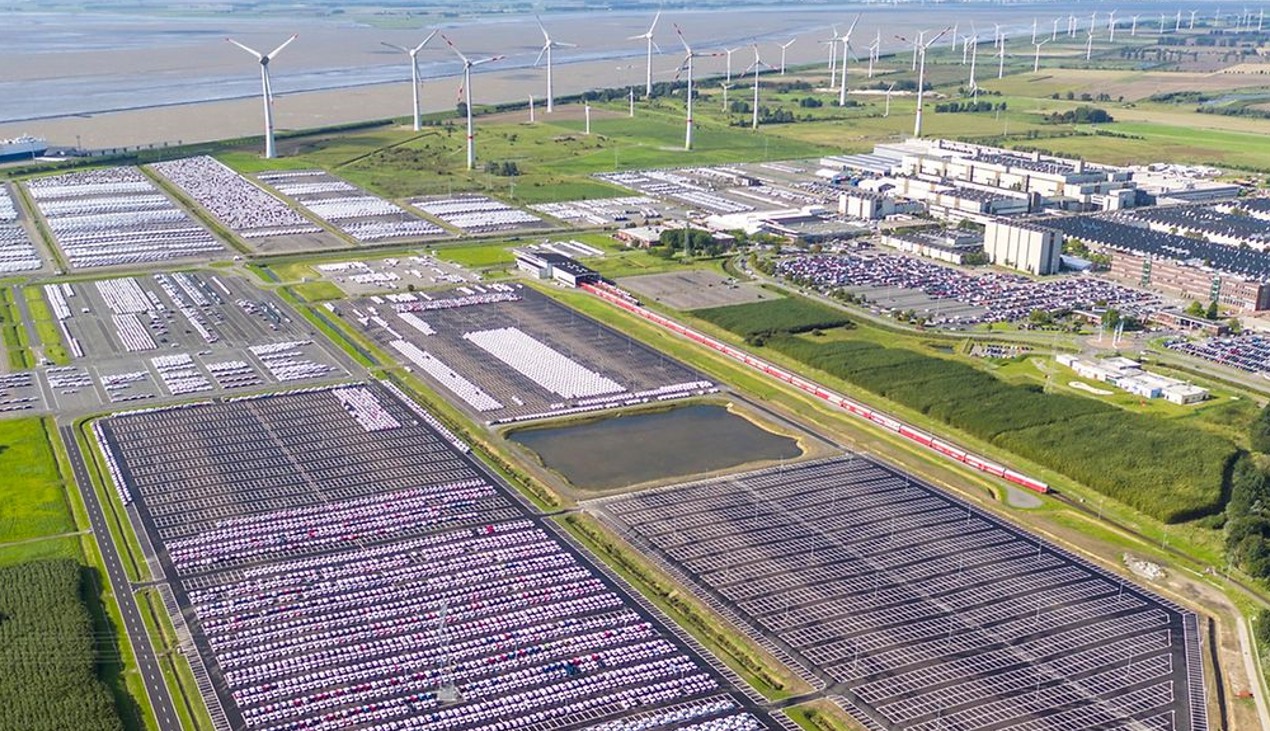
The Deutsche Telekom supports the publicly funded project “AutoLog” in the port of Emden with two innovations from the company. It aims to automate and make workflows at automotive terminals more efficient. For this purpose, Telekom is introducing two new technologies: the 5G network with a special connection (Network API) and an Edge Data Center for fast data processing on-site.
(Bonn/Emden) Together with partners Volkswagen Group Logistics, the Bremen Institute for Production and Logistics (BIBA), and software expert Unikie, new and efficient storage and logistics solutions with automated driving are being developed and tested at the automotive terminal of the Volkswagen plant in Emden.
Automotive terminals are important hubs for logistics in the German automotive industry. Every year, Volkswagen Group Logistics ships about 2.4 million cars from around 40 ports. The largest port in this network is in Emden. The operators of the terminals face many challenges: there are more and more cars to be shipped, but not enough skilled professionals to handle the logistics processes. Additionally, space at the terminals is limited, and expectations for flexibility and efficiency are rising. Therefore, it is now being tested how automated driving can help make processes in vehicle logistics better, safer, and more environmentally friendly, as well as counteract the increasing shortage of skilled workers.
The processes at automotive terminals essentially deal with the handling of vehicles for further transport on various modes of transport (rail, truck, ship). The Emden location is a central hub in the VW Group’s transport network, with a logistics area covering more than 100 football fields. The handling of vehicles at the automotive terminal requires a large number of skilled professionals to carry out the driving movements of the vehicles and the shuttle transports of the drivers to the next driving task. More than 1 million vehicles are handled in Emden each year – including imports from overseas locations and exports for supplying global target markets.
Test Field in Emden Port
For the “AutoLog” project, Telekom is providing comprehensive 5G coverage for the logistics area in the port of Emden. The Volkswagen plant in Emden is directly connected to the port. This allows various traffic situations, such as the mixed operation of manually and automatically driven vehicles, to be tested. The test field includes parking areas for cars, several driving paths, and a heavily used roundabout.
For this test field, a digital twin of the parking areas will be created using LiDAR sensors installed in the port of Emden. The abbreviation LiDAR stands for Light Imaging, Detection, and Ranging and refers to a technology that uses light to measure distances and speeds. These sensors can capture very small details very accurately and in real-time. They perceive everything that moves or stands still – such as people, vehicles, and objects. The sensors have high reliability under different lighting conditions and adverse weather conditions.
5G Network APIs
The software company Unikie provides the system for the automatic control of vehicles, a so-called “Marshalling System.” The digital replica of the parking areas is an essential component of the system. The Unikie Marshalling Solution (UMS) ensures that vehicles can be controlled accurately and safely, even in densely populated or confined areas. Communication with the vehicles takes place via the public 5G network. The LiDAR sensors will also use mobile communication in the future to connect with the UMS, saving the need for complex cabling. A special interface (Quality on Demand Network API) into Telekom’s 5G network ensures stable data transmission. It guarantees consistent quality and reliability of the connection.
Computing Power and Data Storage Closer to the User
Telekom operates the UMS on a so-called Edge Data Center. This ensures that communication between the Marshalling System and the vehicle occurs quickly and securely. With Edge Cloud Computing, computing power and data storage are brought closer to the user.
Unlike traditional cloud computing, which is based on central data centers, these resources in Edge Cloud Computing are located at decentralized points at the edge of the network. They are exactly where the data is generated and used. This improves real-time data processing and enables faster responses to user requests.
Identifying Requirements for Processes
At the test field in Emden port, the partners want to find out what requirements must be created for processes and infrastructure at automotive terminals. They also want to clarify how the technical infrastructure for safe vehicle control must be designed. Additionally, they aim to find ways to improve storage and logistics processes. A major challenge is to safely coordinate automatically and manually controlled vehicles as well as pedestrians at the same time.
The “AutoLog” project aims to demonstrate that the automation of port logistics at automotive terminals has many advantages. For example, it can help compensate for the shortage of personnel, increase safety at work, and make processes more efficient. The partners also see great potential in sustainability: the areas at the automotive terminal can be used about 20% more efficiently. Furthermore, a reduced number of shuttle trips can decrease the kilometers driven and thus also reduce the CO2 emissions of the shuttles by up to 25%.
Key Data on the AutoLog Project
The collaborative project AutoLog (Development of Automated Driving Processes and Dynamic Storage and Logistics Concepts at Automotive Terminals) runs for 3 years and has a total volume of 5.8 million euros. It is funded by the Innovative Port Technologies (IHATEC II) program of the Federal Ministry for Digital and Transport (BMDV) with a total of 3.2 million euros and is supervised by TÜV Rheinland. With this funding, the federal government aims to promote innovative technologies in German seaports and inland ports, thereby increasing their competitiveness. Partners in the project are Volkswagen Group Logistics and BIBA – Bremen Institute for Production and Logistics at the University of Bremen. Associated partners are Deutsche Telekom and Unikie (Munich). The scientific results from this project are also intended to be used for future research. The developments from the project should be transferable to many terminals.
Photo: © Volkswagen


